Popular Place in india.
Popular place in INDIA.
1.TAJ MAHAL
 The Taj Mahal (/ˌtɑːdʒ məˈhɑːl, ˌtɑːʒ-/;[3]meaning "Crown of the Palace"[4]) is an ivory-white marble mausoleum on the south bank of the Yamuna river in the Indian city of Agra. It was commissioned in 1632 by the Mughal emperor, Shah Jahan (reigned from 1628 to 1658), to house the tomb of his favourite wife, Mumtaz Mahal. The tomb is the centrepiece of a 17-hectare (42-acre)[5] complex, which includes a mosque and a guest house, and is set in formal gardens
2.RED FORT.





1.TAJ MAHAL


Construction of the mausoleum was essentially completed in 1643 but work continued on other phases of the project for another 10 years. The Taj Mahal complex is believed to have been completed in its entirety in 1653 at a cost estimated at the time to be around 32 million rupees, which in 2015 would be approximately 52.8 billion rupees (U.S. $827 million). The construction project employed some 20,000 artisans under the guidance of a board of architects led by the court architect to the emperor, Ustad Ahmad Lahauri.
The Taj Mahal was designated as a UNESCOWorld Heritage Site in 1983 for being "the jewel of Muslim art in India and one of the universally admired masterpieces of the world's heritage". It is regarded by many as the best example of Mughal architecture and a symbol of India's rich history. The Taj Mahal attracts 7–8 million visitors a year. In 2007, it was declared a winner of the New7Wonders of the World (2000–2007) initiative.
on three sides by a crenellated wall.
2.RED FORT.

The Lahori Gate is the main entrance to the Red Fort in Delhi. The fort is approached through a covered street flanked by arcaded apartments called the Chhatta Chowk. Situated on the western wall of the fort, the gate received its name because it led to the city of Lahore, in Punjab, Pakistan. The secondary entrance is the Delhi Gate.
The gateway consists of three stories, each decorated with square, rectangular and cusped arched panels. These are flanked by semi-octagonal towers crowned by two open octagonal pavilions. The whole gate is clad in red sandstone, except the roofs of the pavilions, where white stone is used. Between the two pavilions is a screen of miniature chhatris having seven miniature marble domes. Continuing around the whole wall are flame-shaped battlements.
The gate was provided with a 10.5 high metre barbican by Aurangzeb (1658-1707), with its entrance to the north. It is said that Shah Jahan, while under house arrest, wrote to Aurangzeb and criticized his decision: "You have made a fort a bride, and set a veil on it."[1]
Every year since Indian Independence Day in 1947, the national flag has been raised and the Prime Minister has made a speech from the ramparts at the gate. In the 1980s, the security of the area was increased by blocking the tower windows as a security measure against sniper attacks. A lift was also added to the gate.[2]
3.GOLGUBAZ FORT.
Gol Gumbaz is the mausoleum of king Mohammed Adil Shah, Sultan of Bijapur. Construction of the tomb, located in Vijayapura (formerly Bijapur), Karnataka, India, was started in 1626 and completed in 1656. The name is based on Gola gummata derived from Gol Gombadh meaning "circular dome".[1]It follows the style of Deccan architecture.[2]


Architecture

Plan of Gol Gumbaz
The structure is composed of a cube, 47.5 metres (156 ft) on each side, capped by a dome 44 m (144 ft) in external diameter. Eight intersecting arches created by two rotated squares that create interlocking pendentivessupport the dome. At each of the four corners of the cube, is a dome-capped octagonal tower seven stories high with a staircase inside.[2] The upper floor of each tower opens on to a round gallery which surrounds the dome. Inside the mausoleum hall, is a square podium with steps on each side. In the middle of the podium, a cenotaph slab on the ground marks the actual grave below, "the only instance of this practice" in the architecture of the Deccan sultanates. In the middle of the north side, "a large semi-octagonal bay" protrudes out.[2] With an area of 1,700 m2(18,000 sq ft),[3] the mausoleum has one of the biggest single chamber spaces in the world. Running around the inside of the dome is the "Whispering Gallery" where even the softest sound can be heard on the other side of the mausoleum due to the acoustics of the space.[3]
Gallery


References
- ^ "Gumbad (Gumbad) meaning in English". Hinkoj.com. Hinkoj.com. Retrieved 3 August 2014.
- ^ a b c Michell, George; Zebrowski, Mark (1999). Architecture and Art of the Deccan Sultanates. The New Cambridge History of India. I.8. Cambridge, UK: Cambridge University Press. pp. 92–4. ISBN 0-521-56321-6. Retrieved 14 September 2011.
- ^ a b Archaeological Survey of India (2011). "Gol Gumbaz, Bijapur". Archaeological Survey of India. Archaeological Survey of India. Retrieved 14 September 2011.
4.CHAR MINAAR.
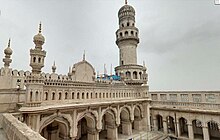
The Charminar ("Four Minarets"), constructed in 1591, is a monument and mosque located in Hyderabad, Telangana, India. The landmark has become a global icon of Hyderabad, listed among the most recognized structures of India. Charminar has been a historical place with mosque on the top floor for over 400 years and also famous for its surrounding markets. It is one of the tourist attractions in Hyderabad. It is where Many local festivals are celebrated in Charminar area like Ramzaan.[1] The Charminar is situated on the east bank of Musi river.[2] To the west lies the Laad Bazaar, and to the southwest lies the richly ornamented granite Makkah Masjid.[3] It is listed as an archaeological and architectural treasure on the official "List of Monuments" prepared by the Archaeological Survey of India.[4] The English name is a translation and combination of the Urduwords Chār and Minar or meenar, translating to "Four Pillars"; the eponymous towers are ornate minarets attached and supported by four grand arches.[3]


Charminar during repair works - August 2016

Mosque on Second Floor
The Archaeological Survey of India (ASI), the current caretaker of the structure, mentions in its records, "There are various theories regarding the purpose for which Charminar was constructed. However, it is widely accepted that Charminar was built at the center of the city, to commemorate the eradication of Cholera", a deadly disease which was wide spread at that time.[5]Muhammad Quli Qutb Shah had prayed for the end of the plague that was ravaging his city and vowed to build a Mosque at the very place where he prayed.[6] According to Jean de Thévenot, a French traveller of the 17th century whose narration was complemented with the available Persian texts, the Charminar was constructed in the year 1591 CE, to commemorate the beginning of the second Islamic millennium year (1000 AH). The event was celebrated far and wide in the Islamic world, thus Qutb Shah founded the city of Hyderabad to celebrate the event and commemorate it with the construction of this building.[7][8]:17–19Due to its architecture it is also called as arc de triomphe of the east.[9]
Historian Masud Hussain Khan says that the construction of Charminar was completed in the year 1592, and that it is the city of Hyderabad which was actually founded in the year 1591.[10]:4 According to the book "Days of the Beloved", Qutb shah constructed the Charminar in the year 1589, on the very spot where he first glimpsed his future queen Bhagmati, and after her conversion to Islam, Qutb Shah renamed the city as "Hyderabad". Though the story was rejected by the historians and scholars, it became popular folklore among the locals.[11]:3,12
Qutb Shah was also among the early poets of Dakhani Urdu. While laying the foundation of Charminar, he performed the prayers in Dakhini couplets, which are recorded as follows:[10]:4[12]
During the Mughal governorship between Qutb Shahi and Asaf Jahi rule, the southwestern minaret "fell to pieces" after being struck by lightning and was repaired at a cost of Rs. 60,000.[13] In 1824, the monument was replastered at a cost of Rs. One lakh.[13]
History
The fifth ruler of the Qutub Shahi dynasty, Sultan Muhammad Quli Qutb Shah, built the Charminar in 1591, after shifting his capital from Golkonda to Hyderabad. Charminar has become a local and national landmark as well as a global icon of Hyderabad.

Clock of the Charminar
The Charminar was constructed at the intersection of the historical trade route that connects the markets of Golkonda with the port city of Machilipatnam.[14]:195 The Old City of Hyderabad was designed with Charminar as its centerpiece.[15] The city was spread around the Charminar in four different quadrants and chambers, segregated according to the established settlements. Towards the north of Charminar is the Char Kaman, or four gateways, constructed in the cardinal direction.[7][14][16][17]:170 Additional eminent architects from Persia were also invited to develop the city plan. The structure itself was intended to serve as a Mosque and Madraasa. It is of Indo-Islamic architecturestyle, incorporating Persian architecturalelements.
Structure

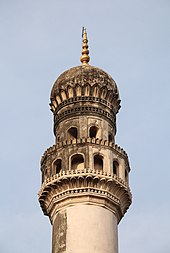
A minaret of the Charminar

Charminar


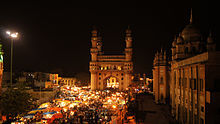
Night View Of Charminar
The Charminar masjid is a square structure with each side 20 meters (approximately 66 feet) long, with four grand arches each facing a fundamental point that open into four streets. At each corner stands an exquisitely shaped minaret, 56 meters (approximately 184 feet) high, with a double balcony. Each minaret is crowned by a bulbous dome with dainty petal-like designs at the base. Unlike the minarets of Taj Mahal, Charminar's four fluted minarets are built into the main structure. There are 149 winding steps to reach the upper floor. The structure is also known for its profusion of stucco decorations and the arrangement of its balustrades and balconies.[18]
The structure is made of granite, limestone, mortar and pulverized marble and it weighs approximately 14000 tones.[19] Initially the monument with its four arches was so proportionately planned that when the fort was opened one could catch a glimpse of the bustling Hyderabad city, as these Charminar arches were facing the most active royal ancestral streets.
There is also a legend of an underground tunnel connecting the Golconda fort to Charminar, possibly intended as an escape route for the Qutb Shahi rulers in case of a siege, though the location of the tunnel is unknown.[20]
A mosque is located at the western end of the open roof; remaining part of the roof served as a court during the Qutb Shahi times. The actual mosque occupies the top floor of the four-storey structure. A vault which appears from inside like a dome supports two galleries within the Charminar, one over another, and above those a terrace that serves as a roof, bordered with a stone balcony. The main gallery has 45 covered prayer spaces with a large open space in front to accommodate more people for Friday prayers.
The clock on the four cardinal directions was added in 1889. There is a vazu (water cistern) in the middle, with a small fountain for ablution before offering prayer in the Charminar mosque.[21]

A night view of Charminar and its surroundings during Ramadan
The area surrounding Charminar is also known by the same name. The market in the areas is famous for jewellery and garments. The monument overlooks another grand mosque called the Makkah Masjid. Muhammad Quli Qutb Shah, the 5th ruler of the Qutb Shahi dynasty, commissioned bricks to be made from the soil brought from Mecca, the holiest site of Islam, and used them in the construction of the central arch of the mosque, hence its name.
A thriving market exists around Charminar: Laad Baazar is known for its jewellery, especially exquisite bangles, and the Pather Gatti which is famous for its pearls. In its heyday, the Charminar market had some 14,000 shops.
Influences

In 2007, Hyderabadi Muslims living in Pakistan constructed a small-scaled quasi replica of the Charminar at the main crossing of the Bahadurabad neighborhood in Karachi.[22]
Pedestrianization Project
The "Charminar Pedestrianization Project" was instituted by the then combined Government of Andhra Pradesh in partnership with the Greater Hyderabad Municipal Corporation.[24] The project was initiated in 2006 with an investment of Rs 35 crore. Out of Rs.35 crore, the share of Central government funds stood at Rs 12.28 crore while the State government gave Rs 5.26 crore.[25][26] However, the project did not see the light of day due various factors such as Telangana movement, illegal encroachments by hawkers, vehicular traffic, and illegal street vendors.[27] Later during January 2017, the new Government of Telangana introduced a 14-member French Delegation to takeover the project to assess the feasibility in developing the monument as an eco-friendly tourism and heritage destination.[28][29] The team has inspected surrounding areas such as the Gulzar house, Macca Masjid, Lad Bazar, and Sardar Mahal. Subsequently, the project took over on a brisk pace and is expected to be completed by May 2018.[25][26][28][29]
👍👍👍
Contact us:-7738776093.
Gmail:-Kattimanisampat85@gmail.com
Youtube channel:-Hack Mob85.
UPLOADED BY:-SAMPAT.KATTIMANI.
UPLOADED BY:-SAMPAT.KATTIMANI.
This comment has been removed by the author.
ReplyDelete